
Bankable energy: How data de-risks solar and storage investment
Across emerging markets, the transition to solar and storage is accelerating. But one barrier remains consistent: a lack of reliable, site-level energy data.
Nigeria is a clear example. With an estimated 1 million diesel generators in operation, self-generation underpins commercial and industrial activity. Yet despite this scale, most systems operate with minimal monitoring. Businesses often lack visibility into how energy is generated, consumed, and paid for.
This has real consequences.
Energy costs for businesses in Nigeria can be up to three times higher per kWh than in the UK, driven by diesel dependency and grid instability. But while costs are high, and increasing, they are rarely well understood. Without accurate data on generator runtime, fuel consumption, or load profiles, inefficiencies remain hidden and unmanaged.
In this context, energy becomes a fixed and unpredictable expense. More importantly, it limits progress.
For many organisations, the move to solar PV or battery storage is not held back by intent, but by uncertainty. Investors and lenders require clear evidence: historical consumption, cost baselines, and projected savings. Without this, projects are difficult to size, justify, or finance.
This is where energy monitoring systems, like enee.io, play a critical role.
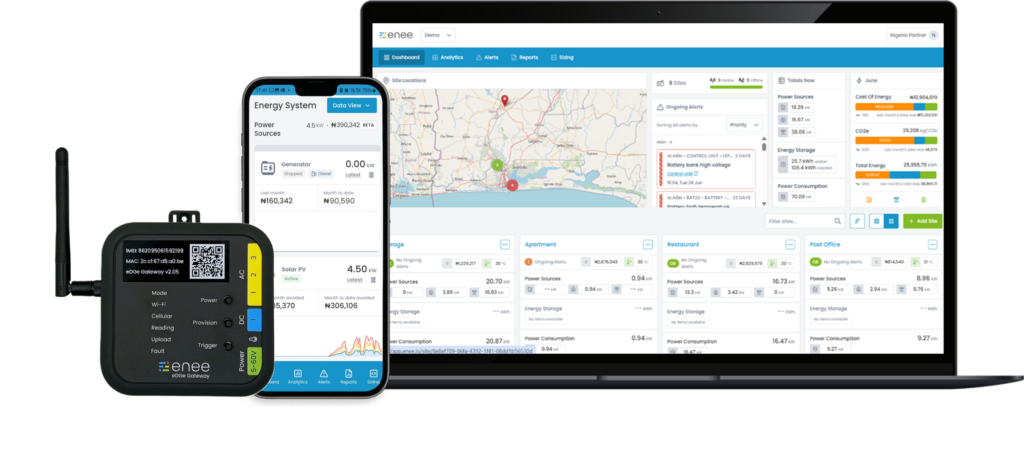
By capturing real-time and historical performance data, monitoring systems provide a foundation for decision-making. They allow operators to understand when generators are running unnecessarily, identify fuel inefficiencies, and establish an accurate cost of energy. The impact is typically threefold.
First, monitoring creates visibility across energy systems.
Second, this enables optimisation — from reducing generator runtime, generator rightsizing, to improving load management.
Third, it delivers savings, often without requiring new infrastructure.
Energy monitoring can deliver strong returns by making existing systems more efficient. By reducing unnecessary generator use, improving load management, and highlighting fuel inefficiencies, businesses can lower energy costs, often by up to 25%, without major capital investment.
Crucially, this data also supports the next step: investment.
With detailed load profiles and verified energy costs, businesses can build credible cases for solar and storage deployment. System sizing becomes more accurate, savings projections more reliable, and financing discussions more straightforward.
Access to operational energy data directly enables businesses to secure funding for solar installations by demonstrating clear return on investment and risk reduction.
As distributed energy markets continue to grow, the role of data is becoming increasingly central.
In environments where energy systems are complex and costs are high, the path to cleaner, more affordable power starts not with new generation — but with better information.
Monitor. Optimise. Save.