
Single trend report – Solar PV skills & jobs in Africa
In October 2025, the International Solar Alliance, in cooperation with the Becquerel Institute, published its flagship report titled “Jobs and Skills in PV in Africa”, mapping how the continent can turn solar ambitions into sustainable employment and inclusive skills development.
Africa installed an estimated 2.6 GW of solar PV in 2024, bringing the cumulative capacity to around 19.2 GW, as per AFSIA. This still represents a modest share of the global 602 GW installed in the same year, and it is just a small fraction of what could be harnessed to tackle energy poverty and power economic development on the continent. Realising this opportunity will depend on the ability of local stakeholders in overcoming various obstacles, such as bottlenecks in jobs and skills.
The “Jobs and Skills in PV in Africa” report presents two PV market deployment scenarios in the region, and it calculates the cumulative jobs that is associated with each of these market scenarios.
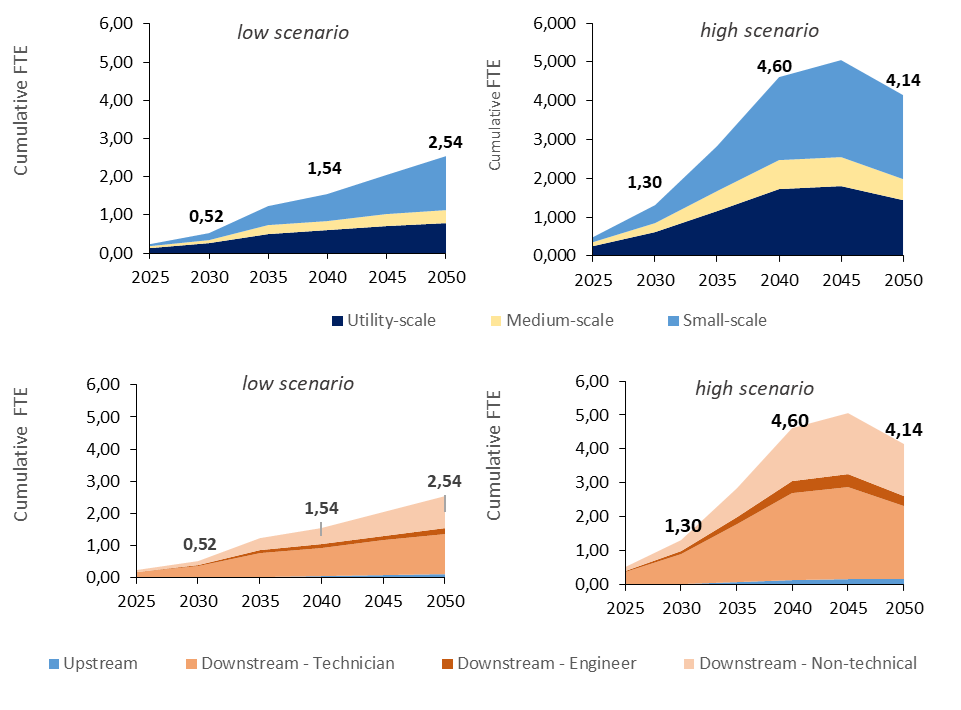
Cumulative jobs per market segment and per job type for the two considered PV development scenarios (in million FTE)
Primary data was collected from around 60 African stakeholders, including government representatives, private companies, industry associations, civil society organisations, research centres, and training institutions. While the authors recognise the great diversity across the African continent and acknowledge that challenges and solutions will vary from country to country, these consultations permitted to identify four main categories of challenges:
- Economy-wide challenges: covering limited administrative capacity, outdated regulations and weak data systems
- Training environment: includes underfunded institutions, outdated curriculum and a lack of formal recognition for solar-specific qualifications.
- Human capital: faces shortages of skilled workers, gender imbalances, and a persistent mismatch between training and actual job requirements.
- Sector-specific: includes fragmented market development, the dominance of small, informal actors in the small-scale segment, reliance on foreign labor, and inadequate integration across the value chain.
To address these barriers, the report proposes a phased approach, also stemming from the primary data collection:
- Laying foundations by establishing robust regulatory and administrative foundations.
- Building and scaling capacity by aligning training systems with real market needs, while developing stable market growth.
- Prepare for future technologies and cooperation by foreseeing technological advancements and promoting digital learning.
- Strengthen regional cooperation to harmonize training standards and certification systems.
The Becquerel Institute is a strategic consulting firm and applied research institute specialising in solar photovoltaics and energy transition. The Becquerel Institute offers unique expertise at the crossroads of technological, economic, and political analysis. It provides strategic advice to companies in Europe, America, Asia, and Africa across all segments of the PV value chain.